
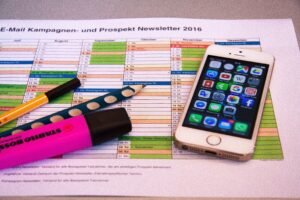
Best daily planner apps for people who actually forget their planner became a real search for me after I bought a genuinely beautiful physical planner — leather cover, thick pages, the whole thing — and left it on my kitchen counter for eleven straight days while I ran my entire life from memory and a stack of sticky notes.
That planner cost more than I’d like to admit. I used it for exactly six days before the pattern started: forget it at home, forget it in the car, forget it existed entirely by the second week. The problem was never the planner itself. It was that a planner only works if it’s physically with you, and mine consistently wasn’t.
Best daily planner apps for people who actually forget their planner solve this by removing the “leave it somewhere” problem entirely. Your phone is already with you constantly, in a way an eleven-dollar notebook simply never was for me.
Why Physical Planners Fail for a Specific Kind of Person
Physical planners work beautifully for people with a consistent routine — same bag, same desk, same daily rhythm that naturally keeps the planner nearby. That’s genuinely not everyone, and it definitely wasn’t me. This is exactly the gap daily planner apps are built to close for people whose routines aren’t that predictable.
Best daily planner apps for people who actually forget their planner exist for the specific pattern where the planning system itself becomes the thing you forget, which defeats the entire purpose before you’ve written a single task down.
I spent longer than I should have assuming I just needed more discipline — a better bag, a designated spot by the door, some habit that would finally make the physical planner stick. What actually fixed it was accepting that my phone was the one object I never left anywhere, and building my planning system around that reality instead of fighting it.
What Makes a Planner App Actually Work for a Forgetful Person
Before naming specific apps, here’s what I’ve learned matters most for anyone with this exact problem.
It has to live somewhere you’re guaranteed to have it. For most people, that’s their phone. Best daily planner apps for people who actually forget their planner need to be genuinely mobile-first, not a desktop tool with an afterthought app.
Quick capture matters more than beautiful design. A gorgeous planner app that takes thirty seconds to open and log a task will get skipped on busy mornings exactly the way a physical planner does.
Reminders that actually interrupt you. A silent planner sitting unopened does nothing. Push notifications and widgets matter enormously here, since the whole point is removing reliance on remembering to check something.
Syncing across every device you actually use. If your planning lives only on your phone, you’ll hit moments at your laptop where you can’t quickly reference or add something, recreating the same fragmentation problem in a new form. These four things, more than any specific design, are what separate daily planner apps you’ll actually stick with from ones you’ll abandon like a physical planner.
The Daily Planner Apps I’ve Actually Used
Here’s my honest take on the specific apps I’d shortlist for anyone with this exact forgetting problem.
Google Calendar
I’ve written more broadly about setting this up in my guide to using Google Calendar to boost productivity, but it deserves a mention here specifically because it’s already installed on most phones and syncs automatically without any setup. Among daily planner apps for people who actually forget their planner, Google Calendar wins simply by already being somewhere you’ll actually look.
TickTick
TickTick combines a daily task list with a built-in calendar view and genuinely solid reminder notifications that actually interrupt you rather than sitting ignored. The daily planner view specifically shows today’s tasks alongside your calendar, which removes the need to check two separate things — one reason it’s consistently near the top of most daily planner apps comparisons.
Todoist
I covered this tool previously in my guide to the best productivity apps for ADHD, and it’s worth repeating here — Todoist’s quick-add feature lets you log a task in seconds from almost anywhere, which matters enormously for someone whose planning system has to survive being used on the go, in a hurry, between other things. Quick capture speed alone puts it near the top of my personal list of daily planner apps.
Structured
Structured presents your day as a visual timeline rather than a plain list, which mimics the physical feeling of a paper planner page more closely than most apps manage. For anyone who specifically missed the visual layout of a physical planner but not the object itself, this is genuinely one of the closest digital equivalents among daily planner apps out there.
Sunsama
Sunsama pulls tasks from multiple sources — calendar, email, other task apps — into one daily planning view, which solves a slightly different version of the forgetting problem: not forgetting the planner itself, but forgetting that a task existed because it was scattered across three different tools. It’s one of the more thorough daily planner apps for anyone juggling several sources of tasks at once.
Apple Reminders with Time-Based Alerts
For anyone who wants the absolute simplest possible option, Apple Reminders set with specific time-based alerts turns your phone’s default reminder app into a genuinely functional daily planner without needing to install anything new at all. It’s not fancy, but “already on your phone with zero setup” is a real advantage for someone whose planning history is a string of abandoned systems.
Step-by-Step: Building a Planning System You Won’t Forget
This is the exact process I used to finally build a system that survived longer than six days, no matter which of the daily planner apps above you pick.
Step 1: Pick the device you’re guaranteed to have on you. For almost everyone this is a phone, but be honest about your own pattern rather than assuming.
Step 2: Set up widgets on your home screen, not just the app itself. A widget showing today’s tasks means you see your plan without even opening an app, which removes one more step between you and actually checking it.
Step 3: Turn on notifications for anything time-sensitive. Among daily planner apps for people who actually forget their planner, the ones that actually work lean on interruption rather than hoping you remember to check.
Step 4: Build a two-minute morning habit of glancing at the day. Even without a full review, a quick look each morning keeps the plan actually connected to your day instead of existing in isolation.
Step 5: Consolidate instead of spreading tasks across multiple apps. If work lives in one app and personal tasks live in another, you’ve recreated the same fragmentation that made a physical planner fail in the first place.
Real Examples of People Who Made the Switch
These examples show how different people actually land on daily planner apps that survive their real habits, not just their good intentions.
A friend of mine went through six different physical planners over two years before switching to TickTick specifically because her actual problem wasn’t organization — it was that the planner never made it into whatever bag she happened to grab that morning. The app fixed a logistics problem no planner design could have solved.
A colleague who works from a mix of home, coffee shops, and client offices uses Sunsama specifically because his tasks used to scatter across email, Slack, and a notes app depending on where an idea came from. Consolidating everything into one daily view, the way the better daily planner apps do, removed the “wait, where did I write that down” problem entirely.
I personally landed on Google Calendar paired with Todoist for quick capture, after that eleven-day leather planner disaster taught me the actual lesson — the system has to live somewhere I’m already looking, not somewhere I’m supposed to remember to check.
Common Mistakes People Make Switching From Paper to Digital
Nearly every failed switch I’ve seen comes down to one of these five mistakes when trying daily planner apps for the first time.
Mistake 1: Choosing an app based on aesthetics instead of reliability. A beautiful planner app that doesn’t sync well or send reliable notifications will get abandoned exactly like a physical one did. Function matters more than looks here.
Mistake 2: Spreading tasks across too many apps. Using a calendar app for meetings, a separate app for tasks, and yet another for notes recreates the same scattered problem in digital form. Consolidate wherever genuinely possible — the same principle behind why the better daily planner apps combine calendar and tasks in one view.
Mistake 3: Turning off notifications because they feel intrusive. For someone with a genuine forgetting problem, interruption is the entire point. Silencing the one feature designed to solve your actual problem defeats the purpose.
Mistake 4: Not setting up widgets or quick-glance views. If checking your plan still requires opening an app and navigating to the right screen, you’ve only removed half the friction of a physical planner.
Mistake 5: Assuming one failed digital attempt means digital planning doesn’t work for you. I tried and abandoned two apps before TickTick and Todoist actually stuck. The right specific app matters as much as the general approach — not every one of the daily planner apps out there will fit your exact habits on the first try.
My Actual Daily Planning Setup
Here’s what I currently run, after finally solving my own eleven-day leather planner disaster, and landing on my own honest answer to the daily planner apps question:
- Google Calendar — the central view of my actual day, checked via a home screen widget
- Todoist — quick capture for anything that comes up outside a scheduled block
- A two-minute morning glance — part of the routine habits I covered in my guide to building a morning routine that actually works
Two connected tools, checked automatically through widgets rather than a conscious decision to “check my planner” — which was really the whole thing I could never sustain with a physical one.
Final Thoughts
Best daily planner apps for people who actually forget their planner aren’t about being more disciplined than someone who successfully uses a paper system. They’re about acknowledging that a planning tool only works if it’s actually with you, and building around whatever device that honestly turns out to be.
Pick the device you’re guaranteed to have, set up widgets and notifications so checking it takes zero extra effort, and consolidate your tasks into as few places as genuinely possible.
That’s really the whole lesson from my eleven days without a planner I’d paid good money for — the fanciest system in the world does nothing sitting on a kitchen counter. The plainest of the daily planner apps on the phone already in your pocket beats it every time.